What Kind of Off-Road Vehicle Is Right for You?
A Guide to 4x4 SUVs, Trucks, and Crossovers
After documenting off-road trails since 2015, I have built up a pretty deep knowledge base around what works, what does not, and where people tend to get into trouble. Over that time, I have driven off-road trails in more than 27 states in everything from stock vehicles to heavily modified 4x4s. I have also read thousands of trail reviews and spent years looking at community feedback and consensus votes from Trails Offroad members.
Since the pandemic, we have seen more people interested in off-roading, overlanding, and rock crawling for the first time. At the same time, automakers have introduced more SUVs and crossovers with off-road trims, terrain modes, and advertising that suggests they are ready for almost anything.
That combination is what made me want to write this guide.
If you are shopping for a vehicle, trying to decide whether your daily driver can handle a trail, or simply wondering what separates a true off-road vehicle from something that is better suited to dirt roads, the goal here is to help you understand what really matters.
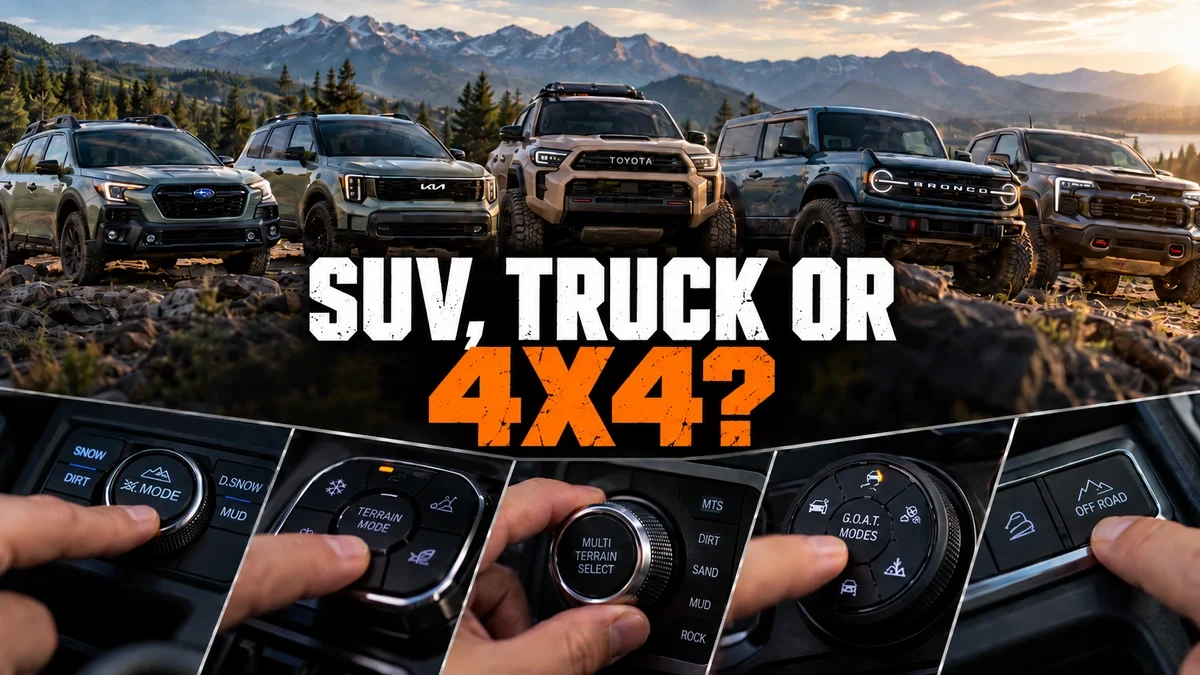
Walk through almost any dealership today and you will find vehicles with names like TrailSport, Wilderness, X-Pro, Tremor, Trailhawk, AT4, and TRD Off-Road. Even vehicles without a dedicated off-road trim may have an Off-Road button, terrain modes, hill-descent control, or all-wheel drive.
That can make it seem like almost any SUV is ready for the backcountry.
It is not quite that simple.
A vehicle can be perfectly capable of traveling a dirt or gravel road without being designed for technical off-road driving. The difference usually becomes obvious when that road stops being smooth and starts throwing rocks, ruts, ledges, washouts, deep sand, or steep climbs at you.
The important question is not simply, “Can my vehicle go off-road?”
A better question is, “What kind of off-road travel was my vehicle actually built to handle?”
When we talk about off-road vehicles in this guide, we are primarily talking about the street-legal vehicles most Trails Offroad members use to explore the backcountry: Jeeps, trucks, SUVs, and increasingly, AWD crossovers. ATVs, side-by-sides, and motorcycles are off-road vehicles too, but their capabilities and trail-access rules are different, so we will touch on those separately at the end.
What Makes a Vehicle Off-Road Capable?
An off-road-capable vehicle is designed with enough traction, clearance, suspension capability, drivetrain protection, and vehicle geometry to travel beyond maintained roads.
But off-road capability exists on a spectrum.
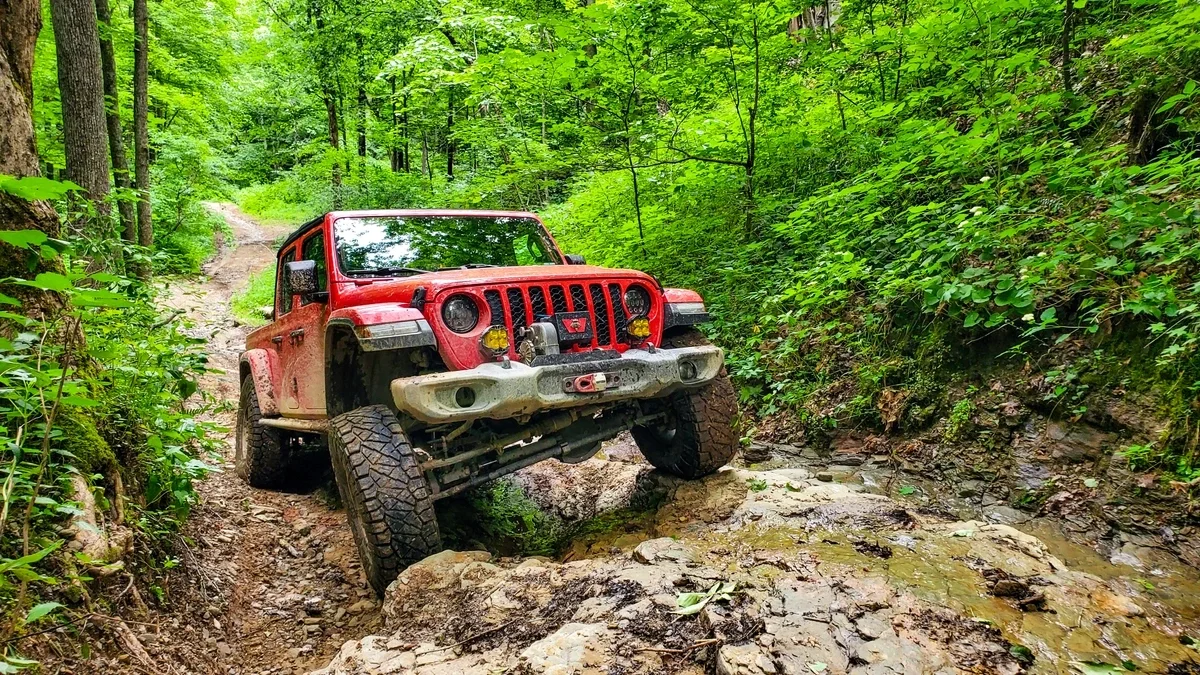
A Jeep Wrangler, Toyota 4Runner, Ford Bronco, Honda Passport, Kia Telluride, Subaru Outback, and Mercedes-Benz GLB can all leave pavement. That does not mean they were designed to do the same things once they get there.
Some vehicles are engineered to negotiate rocks, ruts, steep grades, and uneven terrain. Others are designed primarily for pavement but have enough capability to comfortably travel gravel roads, forest roads, snow-covered roads, and mild backcountry routes.
Understanding where your vehicle falls on that spectrum is more useful than simply asking whether it has four-wheel drive, all-wheel drive, or an Off-Road button.
Even the Right Off-Road Vehicle Needs the Right Equipment
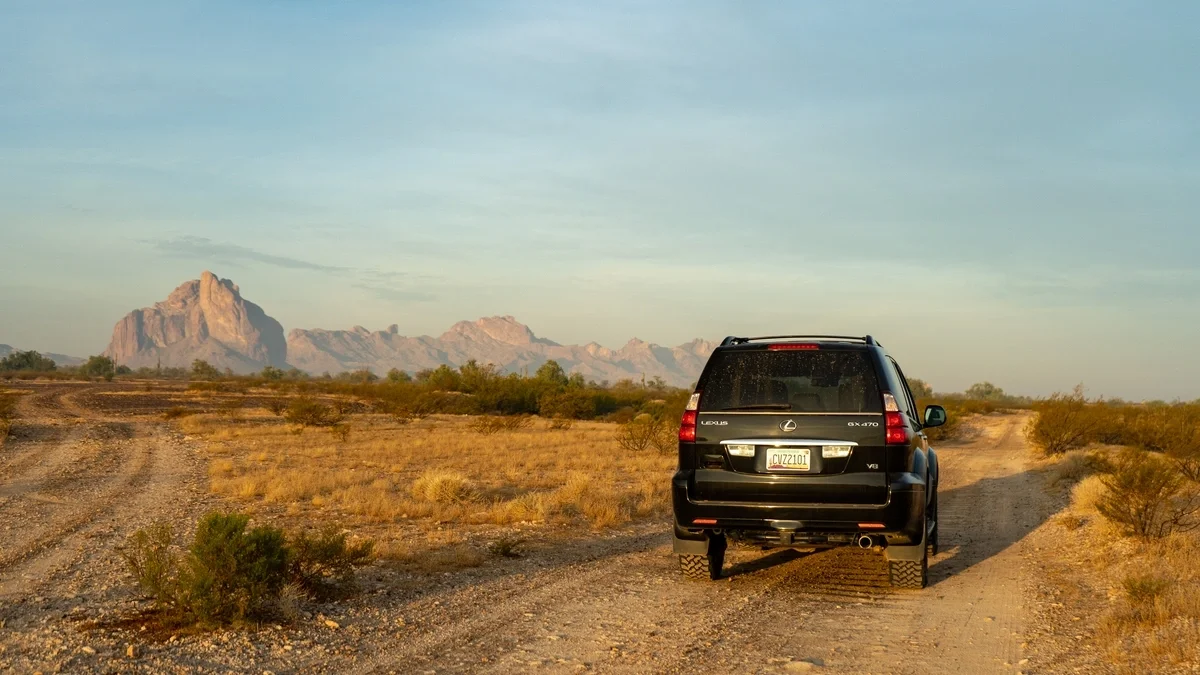
In 2020, I purchased what I considered my unicorn: a 60,000-mile 2008 Lexus GX470.
I was excited to get it out into the Kaibab National Forest. I looked at several Trails Offroad trails on the map, saw green routes rated a 2, and thought it would be perfect. I could go from here, to here, to here and probably cover the whole thing in less than two hours.
At the time, the GX was essentially the way it was when it rolled off the factory floor: stock, with fully aired-up street tires.
I was in for a surprise.
The GX470 has the bones of an excellent off-road vehicle. It has a strong four-wheel-drive system, low-range gearing, and a platform that can become extremely capable. What I learned that day was that having the right vehicle platform is not the same thing as having a vehicle that is ready for the trail in its current configuration.
Street tires, tire pressure, stock clearance, vehicle geometry, and the condition of the road mattered far more than I had appreciated when I looked at that little green line on the map.
I later replaced the tires with E-rated mud-terrains, added an air-down and air-up kit, and took the GX on trails all over the West that did not require additional clearance. I had not transformed it into an entirely different 4x4. I had simply equipped it better for the kind of travel I wanted to do.
Those 2-rated roads took far longer to drive than I expected, and I had to be careful negotiating sections because of the limited ground clearance.
That experience changed the way I think about vehicle capability. A green trail is still a trail. A difficulty rating tells you about the road, but it does not automatically tell you how your particular vehicle, tires, equipment, or experience will interact with it.
The same principle applies when comparing vehicles themselves. With so many SUVs and trucks now marketed for off-road use, it helps to understand what they were actually designed to do.
Understanding the Three Types of Off-Road Vehicles
Based on what we have seen on trails over the years, I think of today’s street-legal off-road vehicles in three broad groups. These are not rigid classifications, but they provide a useful starting point for understanding what a vehicle was designed to do.
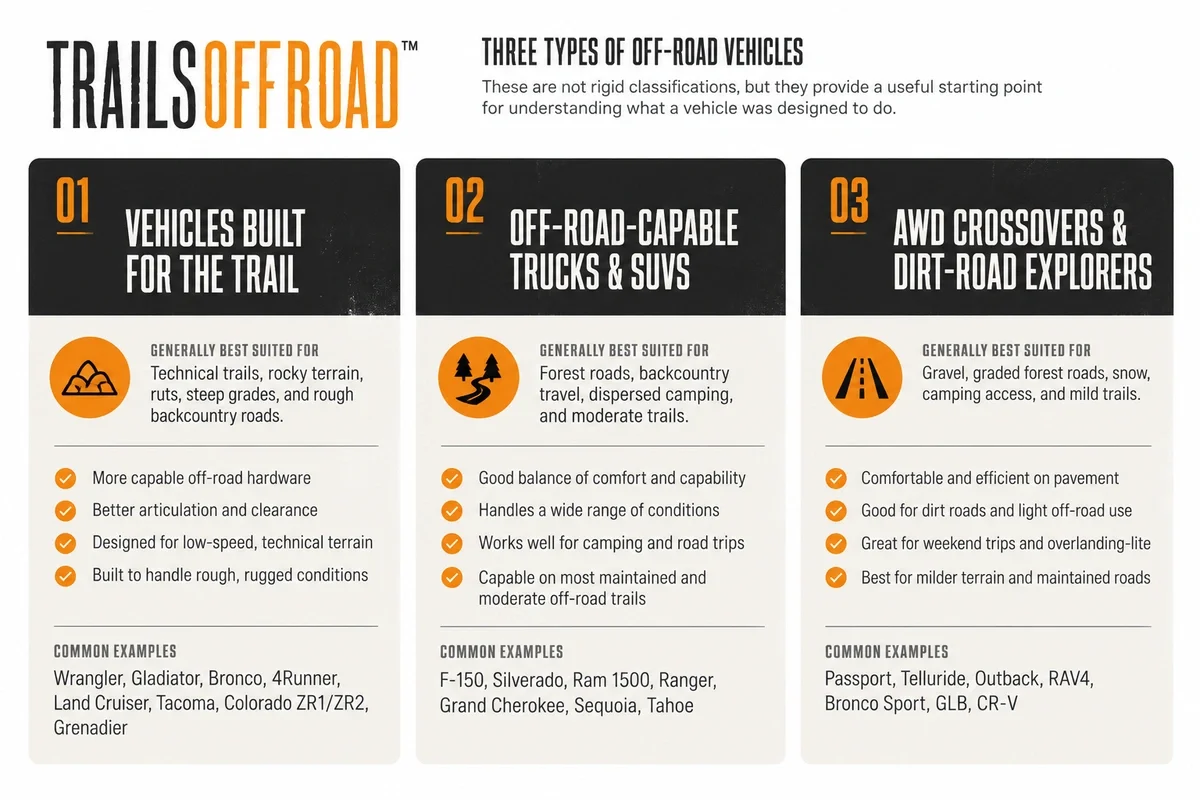
Where a particular vehicle fits can change by trim, tires, equipment, and dimensions, so it is worth looking at each group in more detail.
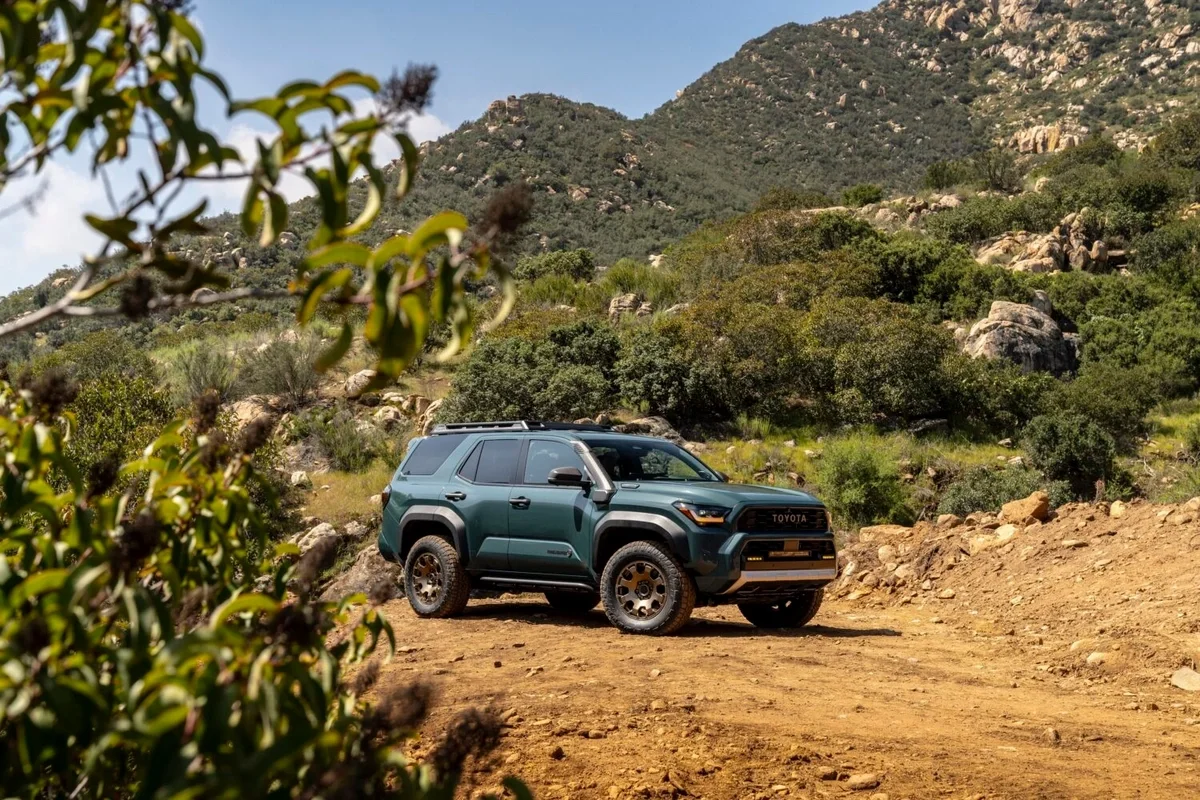
Vehicles Built for the Trail
At the more capable end of the spectrum are vehicles developed with legitimate off-road use as part of their purpose.
This category most closely aligns with what Trails Offroad thinks of when evaluating trails for a stock SUV or stock 4x4.
Examples include:
-
Jeep Wrangler
-
Jeep Gladiator
-
Ford Bronco
-
Toyota 4Runner
-
Toyota Land Cruiser
-
Toyota Tacoma
-
Chevrolet Colorado Z71 and ZR2
-
Ineos Grenadier
-
Ineos Quartermaster
There are meaningful differences between models, trims, and configurations, but these vehicles generally start with many of the fundamentals needed for trail use.
Depending on the vehicle, that may include four-wheel drive, useful ground clearance, favorable approach and departure angles, low-range gearing, suspension travel, more durable off-road tires, skid protection, recovery points, locking differentials, or electronic systems designed specifically for uneven terrain.
Most importantly, the vehicle was developed with the expectation that owners would leave maintained roads.
That does not make any of them invincible. A stock Wrangler can still get stuck. A Tacoma can still drag its belly and bump its tail. A long-wheelbase Gladiator can struggle where a shorter vehicle does not. A capable 4x4 on street-oriented tires can still suffer a sidewall failure.
But you are generally starting with a platform designed for the environment.
Off-Road-Capable Trucks and SUVs
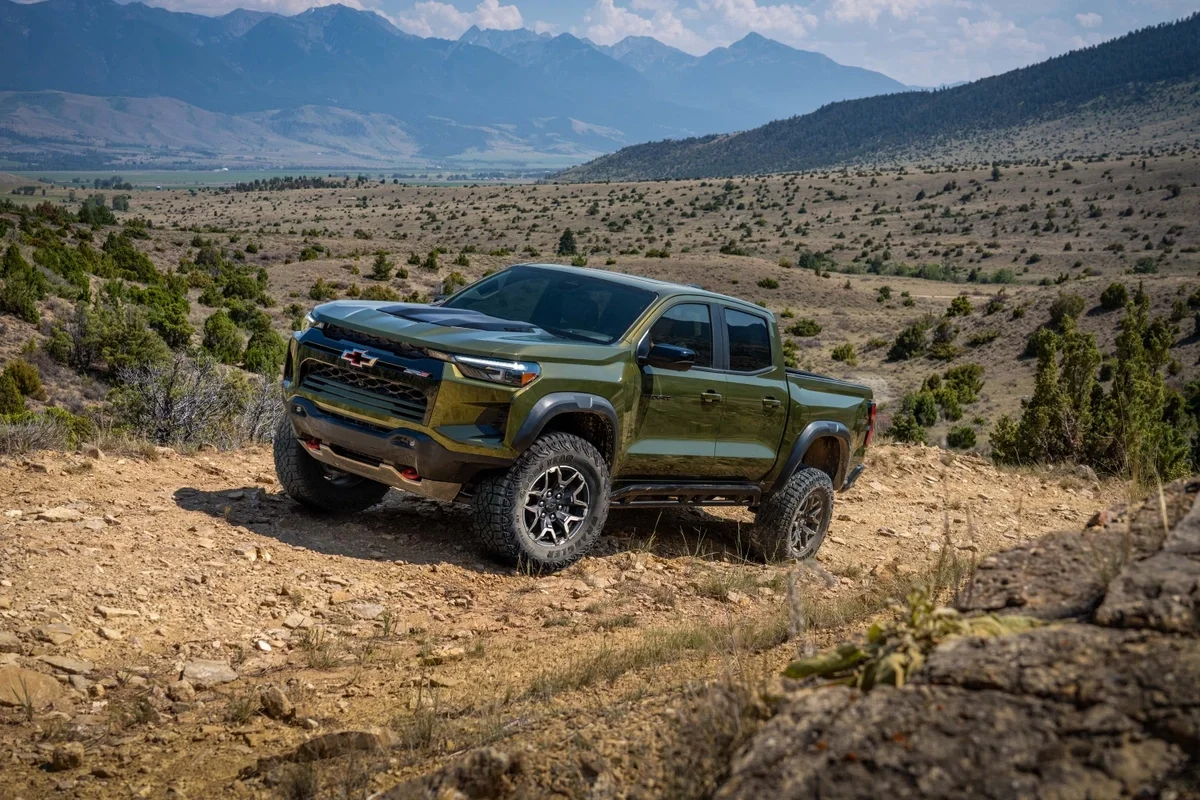
The next category is broader.
Many traditional trucks and SUVs are very capable off pavement even when technical trail driving was not their primary mission. Think Ford F-150, Chevrolet Silverado, Ram 1500, standard versions of the Tacoma, Ranger and Colorado, Jeep Grand Cherokee, Toyota Sequoia, Chevrolet Tahoe, and similar vehicles.
These can make excellent exploration vehicles. Their biggest limitation is often not traction. It is size and geometry.
A full-size pickup may have four-wheel drive, excellent ground clearance, and plenty of power, yet still be a poor fit for a narrow trail. A long wheelbase can create breakover problems. Long front and rear overhangs can contact terrain where a shorter SUV clears without difficulty.
A narrow shelf road, tight switchback, deep cross-axle rut, or limited turnaround can make a trail significantly more difficult in a long or wide vehicle.
That is why a description such as “4WD recommended” never tells the whole story. You also need to know what the trail actually looks like.
AWD Crossovers and Dirt-Road Explorers
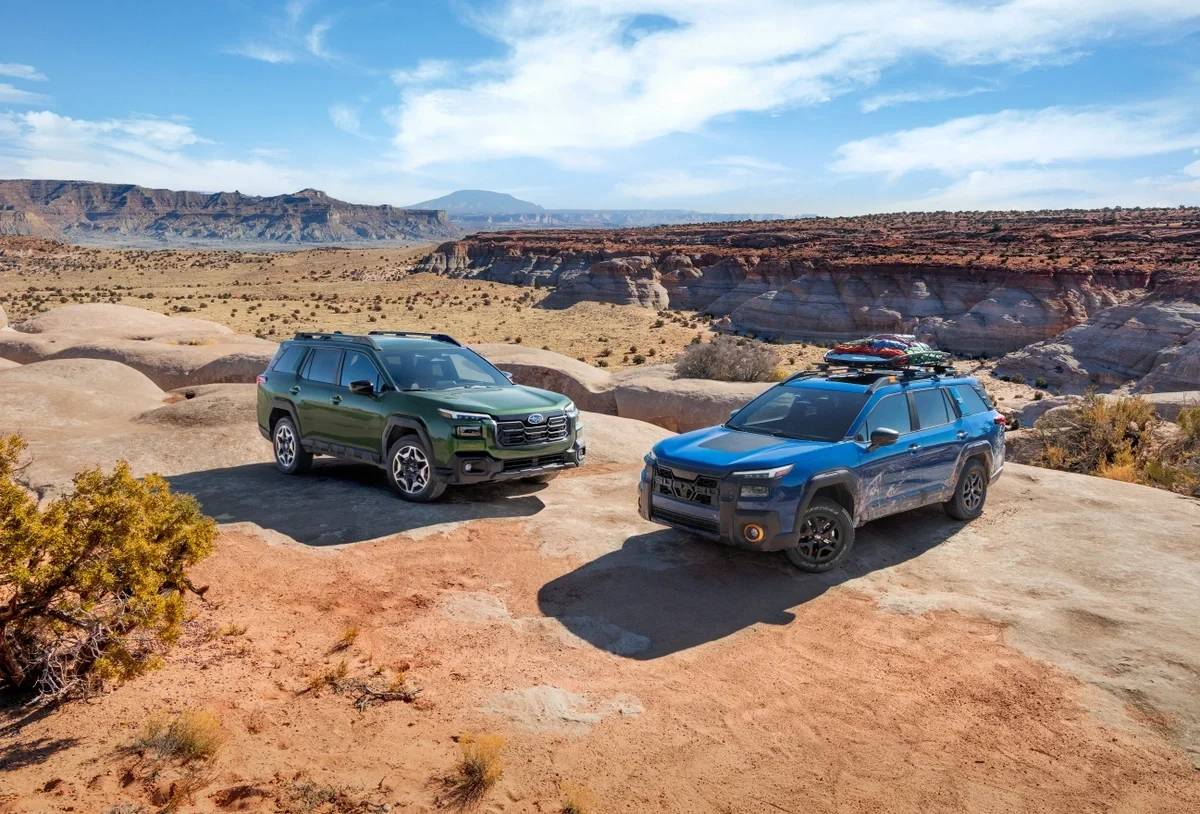
Then there is the category that has grown enormously over the last decade: crossovers and SUVs intended primarily for pavement but equipped to handle dirt roads and mild backcountry travel.
Vehicles such as the Honda Passport, Honda Pilot, Kia Telluride, Kia Sorento, Subaru Outback, Toyota RAV4, Ford Bronco Sport, Mercedes-Benz GLB, Honda CR-V, and similar AWD crossovers fit broadly within this group.
For many people, one of these vehicles may actually be the right choice.
Not everyone wants or needs a dedicated trail vehicle. You may need one vehicle that commutes during the week, carries the family, handles long highway trips, and still gets you to a dispersed campsite or onto a forest road on the weekend.
If most of your exploring involves graded forest roads, maintained BLM roads, gravel, snow, dispersed camping routes, and mild rocky roads, an AWD crossover or road-oriented SUV can be an excellent compromise.
The problem comes when we confuse “capable of leaving pavement” with “built for technical off-road travel.”
I own a Mercedes-Benz GLB that has an Off-Road mode. It works well for what the vehicle was designed to do, but pressing that button does not make it a Wrangler. It cannot add ground clearance, improve the approach angle, install taller tire sidewalls, create low-range gearing, or protect vulnerable components underneath the vehicle.
And this is where automotive marketing can make things confusing.
Over the years, we have talked with friends at various off-road rescue and recovery organizations. Every so often, they will tell us about a recovery involving a vehicle that makes me think, What was that person thinking taking that out there?
Then I remember how many of those vehicles are marketed.
That same SUV may appear in a television commercial climbing a rough road, splashing through water, or sitting beside a remote campsite. From the owner’s perspective, taking it off-road may have seemed completely reasonable.
And in many cases, it is. The important question is which road.
There is a big difference between driving a graded forest road to a campsite and negotiating a trail with ledges, deep erosion, large rocks, steep climbs, or significant cross-axle terrain.
If your daily driver also needs to be your off-road vehicle, buy for the kind of terrain you realistically want to explore, not simply the terrain shown in the commercial.
What Actually Determines Off-Road Capability?
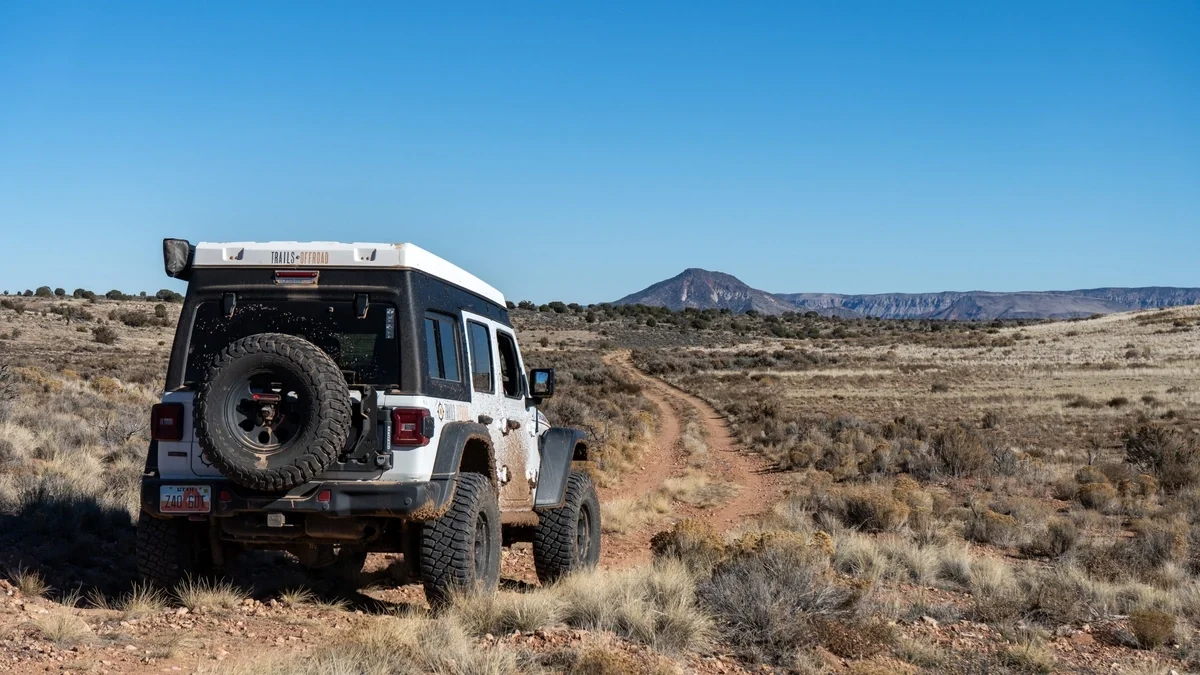
Whether you drive a Wrangler, Tacoma, Passport, Bronco, Outback, or something entirely different, six characteristics have an enormous effect on what your vehicle can comfortably handle off-road.
Ground Clearance
Ground clearance determines how much room you have between the trail and vulnerable components underneath the vehicle. Rocks, ledges, and deep ruts quickly expose the limitations of a low vehicle.
Tires
Tires can dramatically change how a vehicle performs away from pavement. Street tires may be perfectly suitable for maintained dirt roads but become more vulnerable to punctures and sidewall damage in rocky terrain. Tire pressure matters too.
Vehicle Geometry
Vehicle geometry includes approach angle, departure angle, and breakover angle. These determine whether your bumpers or underbody clear abrupt changes in the terrain.
Traction and Gearing
Traction and gearing affect how effectively the vehicle can move through steep, loose, slippery, or uneven terrain. Four-wheel drive, locking differentials, traction-control systems, and low-range gearing can all increase capability.
Vehicle Width
Vehicle width matters on narrow shelf roads, between trees or rocks, and anywhere the trail provides limited room for maneuvering. An easy trail in a Wrangler can feel very different in a full-size pickup.
Wheelbase and Overall Length
Wheelbase and overall length matter on breakovers, tight switchbacks, and turnaround areas. A vehicle can have plenty of traction to continue forward and still simply be too long for the terrain.
These physical characteristics matter far more than the badge on the tailgate.
Match Your Vehicle to the Off-Road Trail
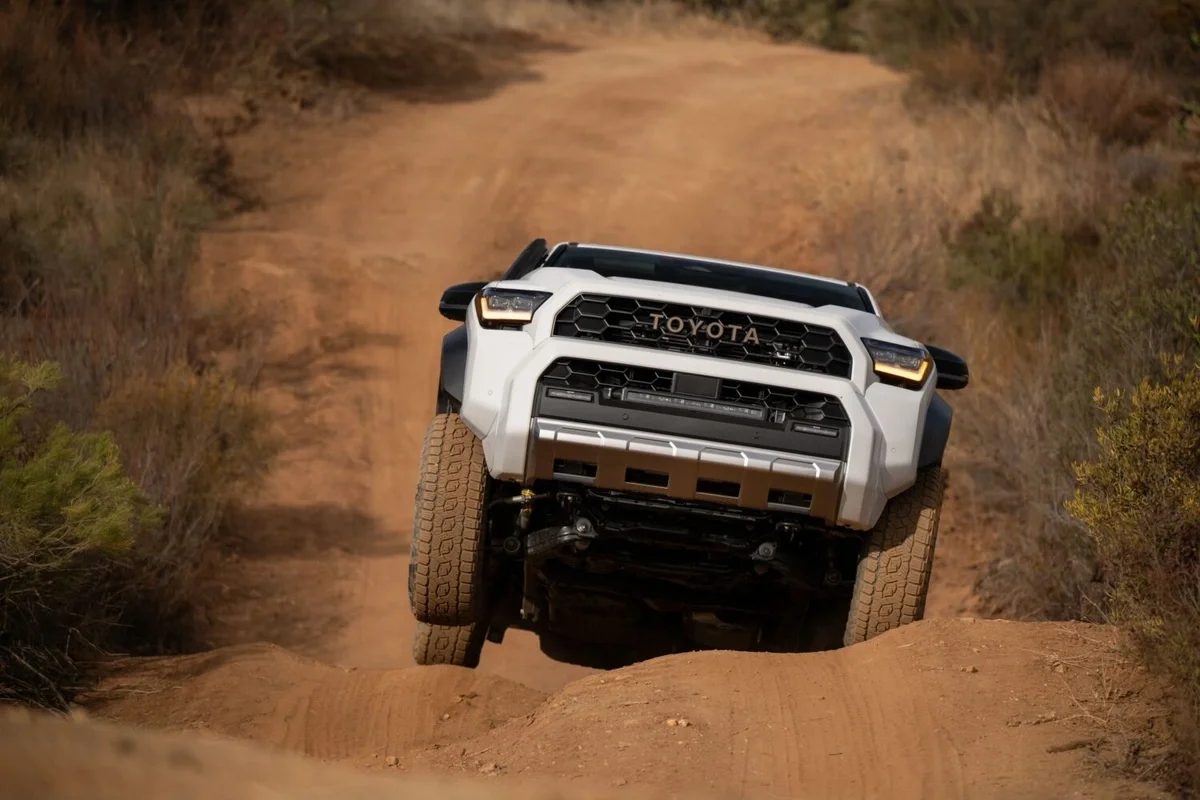
Choosing the right off-road trail takes more than looking at a difficulty number. You need to understand what creates that difficulty and compare it with the vehicle you are driving.
That is one of the reasons Trails Offroad Trail Guides document what is actually on the road.
Our writers drive the trails and record obstacles, road surfaces, ledges, steep sections, shelf roads, water crossings, road width, camping opportunities, mapped waypoints, photos, technical ratings, and changing trail conditions.
Those details provide context that a simple “easy,” “moderate,” or “difficult” label cannot.
A ledge may be straightforward in a Jeep Wrangler Rubicon but require a completely different decision in an AWD crossover on street tires. Likewise, a trail with few technical obstacles may still be a poor choice for a full-size pickup because of narrow shelf sections, tight switchbacks, or limited turnaround space.
Our goal is to show you enough of the trail before you get there that you can decide whether it fits your vehicle, your experience, and the kind of trip you want to have.
If you drive a Passport, Outback, Telluride, GLB, RAV4, or another crossover, there are thousands of miles of spectacular backcountry roads available to explore.
If you drive a Wrangler, Bronco, 4Runner, Land Cruiser, Tacoma, Colorado, or another traditional 4x4, you have a larger envelope of terrain available to you, but your tires, trim, modifications, wheelbase, experience, and current trail conditions still matter.
The goal is not to find the most difficult trail your vehicle can survive.
It is to find the right road, explore confidently, and come home without needing one of our recovery friends to come find you.
Know the trail. Know your vehicle.
Want to see how our trail ratings translate to real vehicles and terrain? Our Advanced Technical Rating System breaks down each difficulty level, the obstacles you can expect, and the vehicle capability appropriate for those trails.
What About ATVs, UTVs, and Motorcycles?
ATVs, side-by-sides, and motorcycles are also off-road vehicles, but they operate within a different set of vehicle dimensions, capabilities, and land-use rules.
Many public-land routes have vehicle-width or vehicle-type restrictions. A road open to motorcycles or 50-inch ATVs may not be open to a Jeep, while other routes may be designated specifically for full-size motor vehicles.
Always check the applicable land-management designation before assuming that the term OHV means every type of off-road vehicle is permitted.

Todd is the Founder of Trails Offroad and an avid wheeler who loves to explore new trails whenever and wherever possible. They say necessity is the mother of all invention, which is true for Todd. His want and desire to find passable trails and new nooks and crannies of the Great American west to explore were his reasons behind starting Trails Offroad. On any given day, you can find Todd on an obscure 4x4 trail, curating Trails Offroad guides, or using his legs to hike to an alpine lake.
More Articles
Off-Roading vs. Overlanding vs. 4-Wheeling: What to Call It, and Why No One Agrees
Read More 
Community
Partners

